
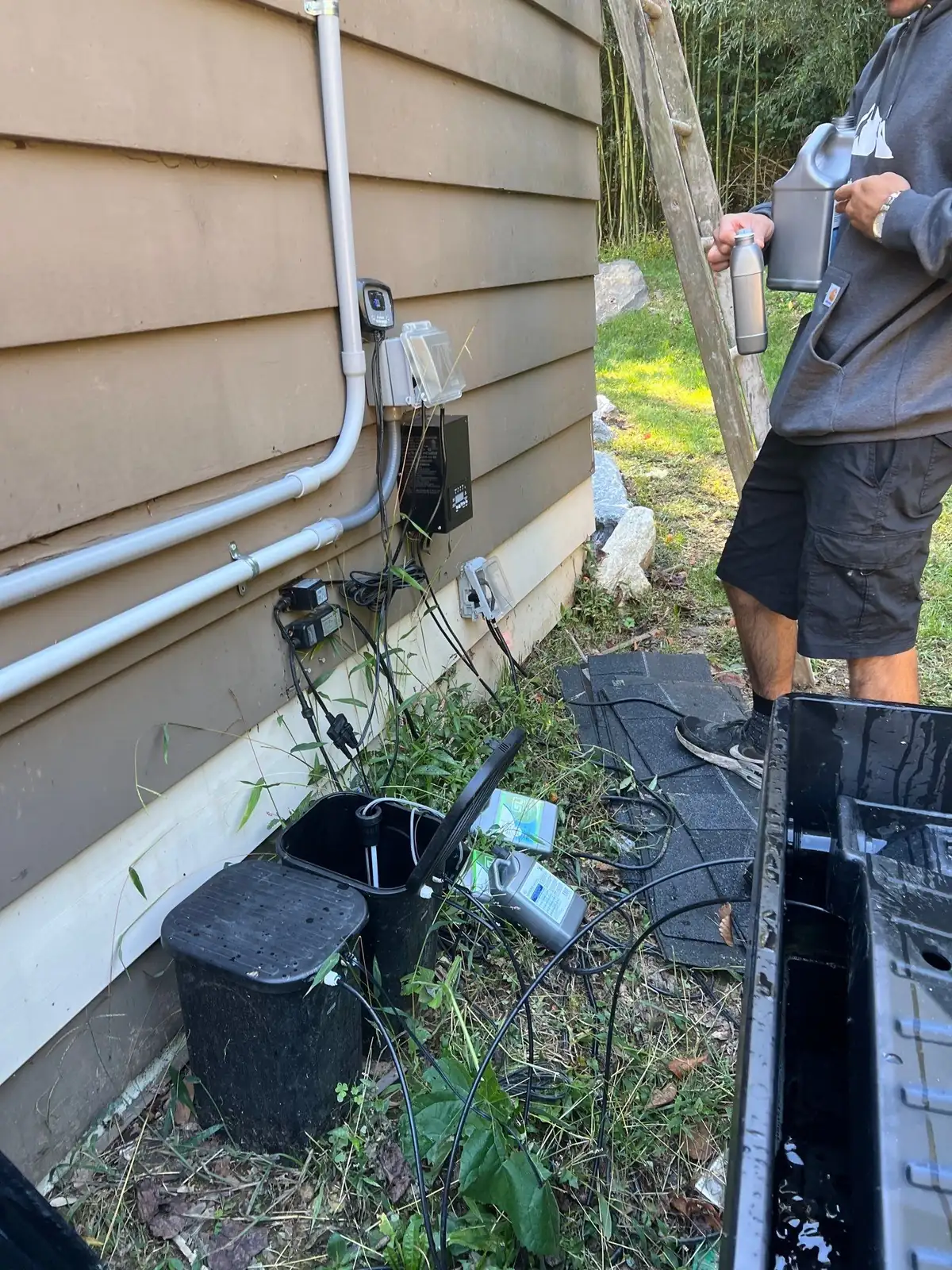
Adequate dissolved oxygen is the single most important factor in a healthy pond ecosystem. Without enough oxygen, fish suffocate, beneficial bacteria die off, algae takes over, and organic debris accumulates on the bottom. Aeration solves all four problems simultaneously by introducing oxygen into the water column and promoting circulation that prevents stratification.
If your pond has ever experienced green water, fish gasping at the surface on hot mornings, or a persistent sulfur smell from the bottom, insufficient aeration is almost certainly a contributing factor. Here is what every pond owner in Delaware and southeastern Pennsylvania needs to know about keeping oxygen levels healthy year-round.
How Dissolved Oxygen Works in Ponds
Dissolved oxygen (DO) is the amount of oxygen gas suspended in water, measured in milligrams per liter (mg/L). Healthy ponds maintain DO levels between 6 and 10 mg/L. Koi and goldfish need a minimum of 5 mg/L to thrive, and levels below 3 mg/L become life-threatening.
Oxygen enters pond water in two primary ways: through the water surface where air and water meet, and through photosynthesis by aquatic plants and algae during daylight hours. Oxygen leaves the water through fish respiration, decomposition of organic material on the pond bottom, and bacterial activity in the biological filter.
Why Warm Water Holds Less Oxygen
This is the critical point that catches pond owners off guard every summer. Cold water physically holds more dissolved oxygen than warm water. At 50 degrees Fahrenheit, water can hold approximately 11 mg/L of oxygen. At 80 degrees, that capacity drops to roughly 8 mg/L. At the same time, fish metabolism and bacterial activity both increase with temperature, meaning oxygen demand goes up precisely when supply goes down.
In our Delaware and southeastern Pennsylvania service area, pond water temperatures routinely reach 78 to 85 degrees from mid-June through August. This is exactly when aeration becomes non-negotiable. Without supplemental aeration, your pond enters an oxygen deficit that compounds daily until something fails — usually the fish or the biological filtration, often both.
Types of Pond Aeration Systems
There are three primary aeration methods for residential and estate ponds. Each works differently, and most well-designed ponds benefit from a combination of two or more.
Surface Aeration (Waterfalls and Fountains)
Waterfalls are the most common aeration source in decorative ponds. As water cascades over rocks, it breaks into droplets and thin sheets that expose maximum surface area to the air. The turbulence at the base of a waterfall is where the majority of oxygen exchange happens — not at the top.
Surface aeration is effective for the upper portion of the water column, but it has limitations. In ponds deeper than 24 inches, the oxygenated water near the surface does not mix well with the cooler, oxygen-depleted water at the bottom. Fish retreat to deeper, cooler water during summer heat, but that deeper zone is precisely where oxygen levels are lowest without supplemental aeration.
If your pond relies solely on a waterfall for aeration, run it continuously during summer — 24 hours a day. Shutting off the waterfall overnight (when plants stop producing oxygen through photosynthesis) creates the lowest oxygen levels of the day just before dawn, which is when most summer fish kills occur.
Subsurface Aeration (Air Pumps and Diffusers)
Subsurface aeration is the most effective method for deep oxygenation. An air pump sits outside the pond and pushes air through tubing to diffuser stones placed on the pond bottom. As bubbles rise through the water column, they transfer oxygen at every depth and create a vertical circulation pattern that prevents thermal stratification.
This bottom-up circulation is critical. It brings oxygen-depleted water from the bottom to the surface for gas exchange and pushes oxygenated surface water down to where fish congregate during hot weather. The result is more uniform oxygen distribution throughout the entire pond, not just the top few inches.
Key specifications to consider when sizing an air pump:
- Pond volume — You need approximately 1 cubic foot per minute (CFM) of air output for every 1,000 gallons of pond water. A 3,000-gallon pond needs roughly 3 CFM.
- Depth — Deeper ponds require pumps with higher operating pressure. Standard diaphragm pumps work well to 6 feet. Beyond that, you may need a rotary vane or piston compressor.
- Diffuser placement — Position diffusers in the deepest zone of the pond. For ponds with multiple deep pockets, use multiple diffuser stones connected to a manifold.
- Noise — Quality diaphragm air pumps operate at 40 to 50 decibels, comparable to a quiet conversation. Avoid cheap aquarium pumps that vibrate loudly and lack the pressure to push air to depth.
Venturi Aeration (Inline Injection)
Venturi aerators inject air directly into the plumbing line using the Venturi effect — water flowing through a constriction creates a vacuum that draws in air through a side port. This method adds oxygen to water as it circulates through the filtration system, and it requires no additional electricity beyond what the circulation pump already uses.
Venturi aeration works best as a supplement to other methods. It increases dissolved oxygen in the filtration loop but does not address bottom-level oxygen depletion the way a subsurface diffuser does.
Signs Your Pond Needs Better Aeration
Most ponds do not fail dramatically from low oxygen. The decline is gradual, and symptoms often get blamed on other causes before aeration is investigated. Watch for these indicators:
- Fish gasping at the surface — Fish gulping air at the water surface, especially in early morning, is the clearest sign of oxygen depletion. This typically happens between 4 and 7 AM when overnight respiration has consumed available oxygen and plants have not yet begun producing it through photosynthesis.
- Fish congregating near the waterfall — When fish cluster in the turbulent zone at the base of your waterfall rather than distributing throughout the pond, they are seeking the highest oxygen concentration available.
- Persistent green water despite UV clarification — Algae thrives in low-oxygen environments because beneficial bacteria that compete with algae for nutrients cannot function without adequate oxygen. If your UV clarifier clears planktonic algae but it returns within days, low DO levels may be undermining your biological filtration. Read more about this in our algae control guide.
- Sulfur smell from the pond bottom — A rotten egg odor indicates anaerobic decomposition — organic matter breaking down without oxygen. This produces hydrogen sulfide, which is toxic to fish even at low concentrations. It signals a completely deoxygenated bottom layer.
- Thick sludge accumulation — Without oxygen, the beneficial bacteria that decompose fish waste, fallen leaves, and dead plant material cannot do their job. The result is a growing layer of black, anaerobic sludge on the pond bottom that releases nutrients back into the water column, feeding more algae.
If any of these symptoms are present, supplemental aeration should be your first intervention — before adding chemicals, treatments, or additional filtration. Oxygen is the foundation that makes every other aspect of pond health function properly.
Aeration by Season: A Delaware Timeline
Aeration needs change throughout the year based on water temperature, fish activity, and plant growth. Here is how to manage aeration across all four seasons in our region.
Spring (March Through May)
As water temperatures rise above 50 degrees during your spring startup, fish metabolism reactivates and biological filtration bacteria begin colonizing filter media. Oxygen demand increases gradually. Start running supplemental aerators when water temperature consistently exceeds 55 degrees. This supports the bacterial bloom that establishes your biological filter for the season.
Summer (June Through September)
This is the critical aeration season. Run all aeration equipment 24 hours a day, 7 days a week from June through September. Do not put aerators or waterfalls on timers during summer. As we covered in our summer pond care guide, the overnight period is when oxygen demand peaks and supply is lowest. Every hour your aerator is off during a July night is an hour your fish are at risk.
Monitor fish behavior daily during heat waves when air temperatures exceed 90 degrees for consecutive days. Water temperature can climb 2 to 3 degrees above normal during extended heat events, pushing dissolved oxygen to critically low levels.
Fall (October Through November)
As water temperatures drop below 65 degrees, oxygen capacity increases and fish metabolism slows. Aeration remains important during fall because leaf debris falling into the pond creates a decomposition load that consumes oxygen. Keep aerators running until your fall netting is in place and water temperatures drop below 50 degrees.
Winter (December Through February)
Winter aeration serves a different purpose. Rather than oxygenation, the primary goal is preventing the pond surface from freezing completely. A sealed surface traps toxic gases (ammonia and carbon dioxide) produced by decomposition beneath the ice. A small aerator or de-icer keeps a hole open in the ice for gas exchange. Never position a winter aerator in the deepest zone — this disrupts the thermal stratification that keeps fish alive in the warmest bottom water. Place it on a shallow shelf instead. Your winter shutdown service should include proper de-icer and aerator placement.
Common Aeration Mistakes
Even pond owners who invest in aeration equipment often make installation or operation mistakes that reduce effectiveness:
- Undersizing the air pump — A pump rated for 500 gallons will not adequately aerate a 2,000-gallon pond. Size based on actual pond volume, not the pump manufacturer's marketing claims.
- Placing diffusers too shallow — Diffuser stones placed on shelves or mid-depth miss the bottom zone where oxygen depletion is worst. Always place at least one diffuser at the deepest point.
- Running aeration on a timer in summer — Some pond owners run aerators only during the day. Nighttime is when dissolved oxygen drops to its lowest point. Run aeration continuously from June through September.
- Neglecting airline maintenance — Check airline tubing for kinks, leaks, or algae buildup inside the tubing annually. Replace diffuser stones every 1 to 2 years as they clog with mineral deposits and biofilm, reducing air output.
- Skipping aeration during spring startup — Many pond owners wait until summer to start aerators. Biological filtration bacteria need oxygen from the moment water temperatures exceed 55 degrees. Early aeration accelerates the nitrogen cycle that establishes your filter for the season.
How Professional Maintenance Addresses Aeration
Aeration is one of the first things we assess on every maintenance visit. Our technicians check pump output, diffuser condition, airline integrity, and dissolved oxygen levels at multiple depths. We know from experience that a pond can look fine on the surface while the bottom zone is completely oxygen-depleted — and that is where problems develop that surface-only observation misses.
Our Maintenance Membership programs include aeration assessment and adjustment as part of every scheduled visit. Bronze members receive monthly checks, Gold members get biweekly monitoring, and Platinum members have weekly aeration verification. When we pair aeration optimization with our ClearWater Guarantee filtration system, the result is consistently clear, healthy water with stable oxygen levels throughout the water column.
For pond owners considering an aeration system upgrade, we evaluate your specific pond dimensions, depth profile, fish load, and plant coverage to recommend the right combination of surface and subsurface aeration. There is no one-size-fits-all solution — a shallow 1,500-gallon garden pond has completely different aeration needs than a 6,000-gallon koi pond with a 4-foot deep zone.
Get Your Pond Summer-Ready
Late May is the ideal time to evaluate and upgrade your pond's aeration before the summer heat arrives. If your pond showed any signs of oxygen stress last summer — fish gasping, green water, bottom sludge, or a sulfur smell — do not wait for those problems to return this year.
Contact Rock Water Ponds for an aeration assessment and system recommendation tailored to your pond. Call (484) 844-3863 or request a consultation to get ahead of summer before it gets ahead of your pond.